Spectacle lenses and diagnostic equipment
Spectacle lenses

Spectacle lenses: how they work and how they differ

Spectacle lenses are the part of glasses that actually corrects vision. The frame holds them in front of the eyes, but the lens changes the path of light, focuses it on the retina and decides how comfortable seeing feels.

Book a visit

Image correction

A lens shifts the light focus so the image lands sharply on the retina in myopia, hyperopia, astigmatism or presbyopia.

Design types

There are single-vision, relaxation, office, progressive, photochromic, sunglass and special driving lenses.

Material and coatings

Material affects thickness, weight and durability, while coatings affect reflections, cleaning, UV protection, fogging and screen comfort.

What spectacle lenses are
Basics

What spectacle lenses are

A spectacle lens is a precisely designed optical element. Its task is to change the direction of light rays so the eye can form the image in the right place. A well-fitted lens lets you see more sharply and with less effort.

Lenses differ in power, curvature, design, material, thinning and coatings. What matters for the client is how these parameters affect everyday life: sharpness, field of view, weight, appearance and ease of cleaning.

they correct how light is focused
they work with the eye and the frame
they affect sharpness and eye fatigue
they can be designed for different tasks
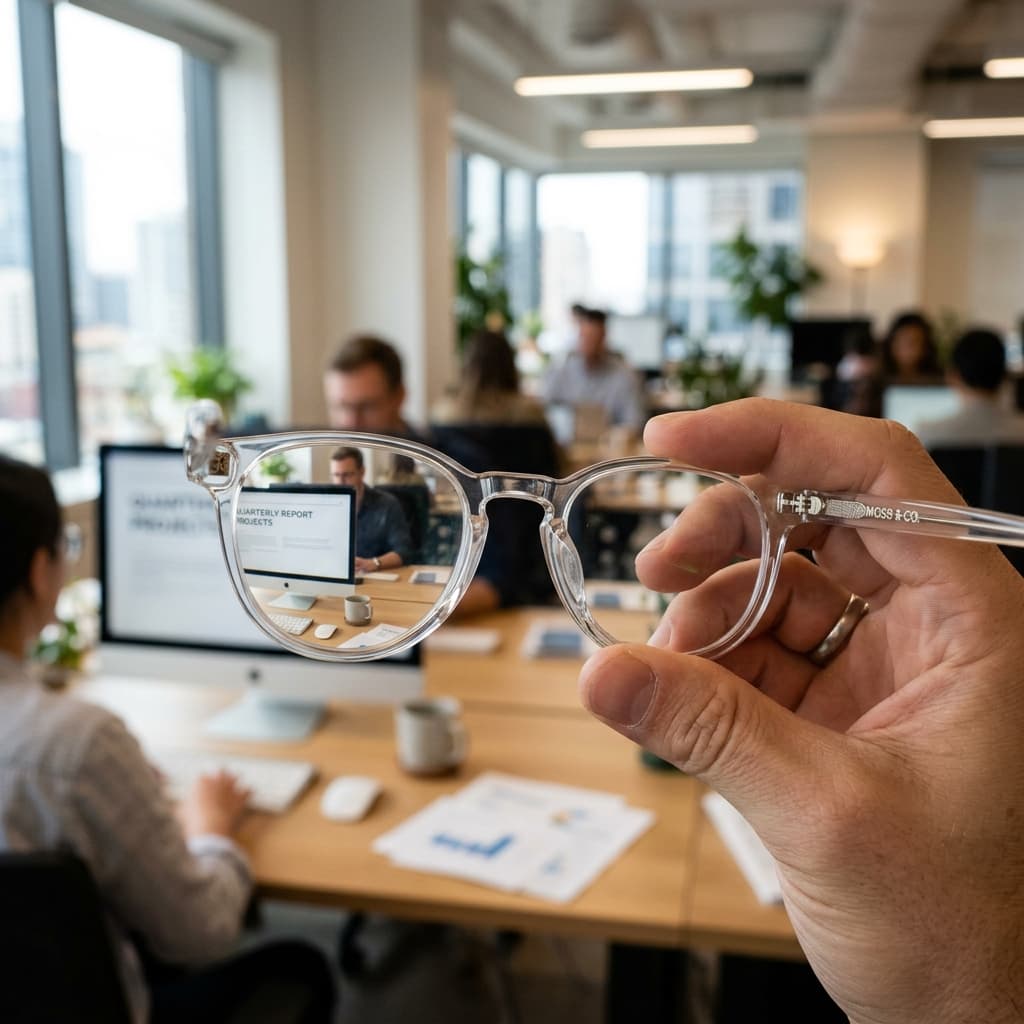
How a lens affects correction and vision
Vision process

How a lens affects correction and vision

In myopia the image forms in front of the retina, so a minus lens moves the focus farther back. In hyperopia the image falls behind the retina, so a plus lens helps move it into place. In astigmatism the lens balances power differences between eye axes.

After the age of 40, near focusing becomes harder. Reading, office or progressive lenses can help. They differ in how many distances they support and how wide the field of view is for specific tasks.

minus lenses for myopia
plus lenses for hyperopia
cylinders for astigmatism
addition for near vision
The most common spectacle lens types
Types

The most common spectacle lens types

Single-vision lenses have one power and are used for distance, near or a specific working distance. Relaxation lenses may relieve eyes during long near work. Office lenses are comfortable for screens and documents, while progressive lenses combine distance, intermediate and near vision in one pair.

There are also photochromic lenses that darken outdoors, prescription sunglasses, driving lenses that reduce glare and children's lenses where impact resistance and UV protection matter.

single-vision for one distance
relaxation and office lenses for near work
progressives for multiple distances
photochromic, sunglass and driving lenses
Thickness, weight, index and coatings
Material

Thickness, weight, index and coatings

Lens material decides whether the lens will be light, thin and durable in everyday use. With higher powers, a higher refractive index can make glasses look more aesthetic and feel lighter.

Coatings do not change lens power, but strongly influence comfort. Anti-reflection reduces glare, hard coating protects against fine scratches, hydrophobic and oleophobic layers make cleaning easier, and UV, Blue Protect, photochromic or anti-fog solutions answer specific needs.

index affects lens thickness
material affects weight and durability
coatings improve everyday comfort
choice depends on prescription, frame and lifestyle

Take care of your eyesight today

Pick the salon that suits you - Łokietka 14 or Żelazna 48 - and book a visit. You'll see the difference.